site with fuel injection for straight eight .

Jyrki, Vortech has compressor maps online. The “T” trim is the closest with a max flow of 82.5 lbs/min (825hp), compression ratio of 2.4 and max rpm of 50k. The ProCharger P-1SC advertises at 825 hp, compression ratio just over 3 and max rpm of 62k. Not quite the same. Garrett turbochargers have online maps. Between the two you can extrapolate something close.

Observation #1: 15 lbs of boost will come in around 5000 rpm with 2.25 overdrive.

Observation#2: 40 lbs/min airflow (400hp) at a compression ratio of 2 (15 lbs of boost) runs near the Surge line on the compressor map. There is margin unless pressure increases or the flow rate is actually less. Increasing the engine VE would help increase margin. The 2.25 gearing is correct for that size supercharger on your engine. We can not step up the gearing without the possibility of driving the compressor into the surge region. Sure would be nice to have the actual compressor map. Thankyou Procharger


You are right, just try what you have, use it as a bench mark and go from there.

What car is this engine in?

Do you have the Procharger?

Just some fun info. I work with Kirk Rogers. He used heads from the shop I mentioned in post #39 to win the 1993 Northwest Series stock car championship with a 101 point lead just before he retired from racing.
We asked them to install seats and valves in the Buick billet head.
 
Last edited:
Paul, good observations. I bought all the stuff - the P-1SC, ECU, injectors - already a year ago. The problem is, running my business seems to consume all the hours of the day. I actually bought a charger kit for a SB Chevy, but I can only use the charger and the tensioner. I gave the specs to the local ProCharger dealer, and they provided the pulleys accordingly. The bracketry needs to be completely custom-built. It's under work.

This is all going into my 1946 Roadmaster Sedanet, see www.roadmachine.fi/Buick/Rmaster.html

Merry X-mas everyone!
 
Jyrki, Thanks for the link to your Buick Site. You did an amazing job fabricating pieces for the car and documenting your progress. You definitely have bragging rights.

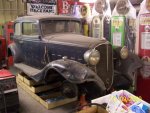
The 1933 50 Series Victoria shown below belongs to Kirk Rogers. His grandmother was the original owner. Kirk is doing the restoration and was talking about replacing the 230 cu. in straight 8 with a Buick nail head V8. I recommended using the 263 S8 which is only 2 inches longer than the 230. This will be a show car so the look he chose was 8 velocity stacks equally spaced at a 45 degree angle with EFI. Target HP is 300 so displacement needs to be around 300 inches. He agreed that the “WOW” factor and the value of the car are better with the original engine configuration. It was decided that making an aluminum head would meet all the goals. http://www.teambuick.com/forums/showpost.php?p=74924&postcount=13

The 263 bore diameter is 3.187”. The beam side of the big end of the connecting rod has a smaller width than the rod cap so it can pass through the cylinder during engine assembly. We feel that this is a weak point and are looking at using Oliver billet rods.

The rod journals on the crank would be offset ground to a 2.00” diameter (Stock is 2.125”) for a .125 stroke increase. If we sleeve the block .200 over there will be plenty of room to accommodate the new rods and give us a displacement of 306 cu. in.

The lifter bores would be sleeved for SBC roller lifters with an oil gallery drilled through the lifter bores (the length of the block) so hydraulic lifters can be used.

The cam would need every other intake and exhaust lobe swapped to accommodate the symmetrical port head. Any past experience on cam regrinds or new billets for the straight 8 would be appreciated.

Have not decided on which EFI system to use but Kirk wants to keep a distributor for appearance sake.

All comments are welcome.
 

Attachments

  • 33Buick11.jpg
    33Buick11.jpg
    42.1 KB · Views: 18
Last edited:
Leave the distributor in as a cam sensor/oil pump drive,[if you use sequential]. And use a trigger wheel attacted to the front pulley with a magnetic sensor. Nothing would look out of place. Locate coil packs to the rear of the distributor and put a cover over them. Should satisfy even some purists.
Doug
 
Maybe this is one of my stupid ideas .
Considering the fact we want a supercharged Str8 ...
Jyrky wants one , and others also do . Many others I think to solve the intake issue .

Why not use a huge plenum and injection inside the plenum ? So fu** the intake design .
The blower will push the mix , and who cares ...

It seems to me , according to my reading , that the only pb of this engines are the intake . The exhaust is not so bad .
So we need to push instead of sucking .
Most of the users would enjoy a 200 HP engine . 300 400 500 is nice but not for daily .
So there may be a easy way .
Blower to avoid the pb of the intake , 3 or 6 PSI , just push ( PUSH ) not Pusch :)

We need a large plenum for the mix , but with a 33 or 42 " long engine there s room .

This is Chrismas enginering ..

I m building a 232 AMC with a M60 Eaton , sure this can work with a str8 .
 
Doug, Thanks for your input on keeping the distributor.
Congratulations on purchasing Mike Cook’s old Lakester. Can’t wait to see you streamlining the straight 8 down the salt.
I’m sure you have posted this before, but who does your camshaft?
Paul
 
39 Cent,
the TBI (Throttle Body Injection) is a viable option. For instance, the Hart/Collison team uses a system together with a roots supercharger, which could be described as TBI.
The reasons why I didn't choose TBI are:

1. I want a symmetrical, "dry" manifold design which requires port EFI
2. The TBI is not that much different from carbs, although it's so much easier to tune.
3. The TBI doesn't work too well with a blow-thru forced induction (turbo or centrifugal supercharger)
4. I get a "kick" out of solving problems. Going with TBI would be too easy for me. I want to go the hard way. That's why I chose not to swap a small-block Chevy in the first place :bgrin:

Nali, Thanks also for your input. It is good to have more people participating in this discussion. All ideas are good.

You are right. Injecting into the plenum can work, but not with Electronic Fuel Injection.

You are also right that a positive displacement blower will force the air into the engine no matter what.

In order to have an even mixture in the plenum, the fuel injection would have to be a constant flow type.


The goal is to make EFI work in the intake ports.

The second goal is to use a centrifugal supercharger.

The reason Why is because no one has come up with a good enough solution for using EFI with siamese intake ports. See above quote, reasons #1 and #4 for details on why.

Paul
 
Last edited:
Yeah I know Paul .
In fact I don t know anything to cars :P
and I I still have pb with english :P
So this make have some ideas noboby cares , Some are nice , most are scarp .
I just try to have ideas . Jirky will try , or I will next summer .
Sure with many brains we ll manage to get a working funny engine .

I had an idea about a M- 90 eaton , or a M - 112 .But wtf .
I ll build it my way .
 
well it s a 7120 jeep head ported by myself . expect the worst :P
with a m 62 eaton compressor from a buick riviera 1995 and a Quadrajet .

I made a 2x3 exhaust .
From SBc headers .
With a 4.0 head I may have 200 HP , too much for the trans Borg Warner T - 35 ..
So it s fun but wont long last , and I don t care :PO
torque tube issue ..
I dont know anything to cars :P
I ll pour a intake make of alu for the quadra / eaton , I cast aluminium .
the Rambler has been my driver since 5 years now :P

sorry this is really OT :P
 
Nali
I looked at your header and manifold fabrication. Looks great. Lots of work.
Also the cylinder head from a Jeep 4.0.
You said something about the M90 and M112
You may already know this. If not I hope this helps

The Eaton superchargers are designed mainly for street use.
The following link is the performance map for the M62.

http://www.eaton.com/EatonCom/ProductsServices/PerformanceProducts/Products/Superchargers/M62/index.htm

You will see the max efficiency island (66%) is around 1.4 to1.5 compression ratio which is between 6 to 8 pounds of boost.
The supercharger RPM is between 5,000 and 7,500 at this point.

Let’s say you want to limit the 232 to 5,000 rpm.
Let’s also say that with head work and a higher lift cam than stock, the cylinder can fill up to 85% at 5,000 rpm. (85%Volumetric Effeciency).

Airflow at 5,000 engine rpm with 7.5 lbs of manifold pressure (1.5 compression ratio) should be about 425 cfm going into the supercharger.

On the performance map, if you draw a line straight up from 425 cfm till it intersects 1.5 compression ratio, the supercharger speed should be close to 8,000 rpm at that point.
With the engine at 5,000 rpm, a 1.6 overdrive pulley set-up will drive the supercharger at 8,000 rpm.
425 cfm is approximately 29 lbs/min of air which is around 290 horsepower.

If you look at the map for the M90 you will see the same intersection point close to 6,000 rpm so the M90 will only need a 1.2 overdrive pulley ratio.
You may also notice that the M90 only has a max efficiency of 62%.

If you look at the M112 you will see that it is too large for a 232 that only revs to 5,000 rpm. One solution is to use a larger engine.

Example: Use a 4.0 liter block with a crankshaft from a 258 and you have a 278 cu in engine. (283 with .030 over).
Now you have 520 cfm at 5,000 rpm and 360 hp with 7.5 lbs of manifold pressure using the M112.

There is a lot more but will stop here. Please ask questions

PS: for those that want to get technical, this discussion is at standard temp and pressure and does not take into account the rise in air temp after compression and any other real life variations. Just wanted to keep it simple.
Paul
 
I m afraid this is really off topic ... Nice to have explanations on how to use the graph about the chargers .
I suppose my set up is not the best , but I have a few reasons about it . One is $$$ :)
- I had the m62 for free , a friend of mine gave it to me . I first wanted to use a 3 carbs intake with some Rochester B I have .
- I can t build a stroker on this engine . A AMC pré 1972 does n t share the same bolt pattern as a 4.0 . So I d need a 4.0 engine . then the issue is the car has a torque tube . So I d need to use an open axle , modify the rear to use a "regular"suspension , etc .. Doable , but a lot of work .
- The main reason why I wanted to use a blower is noise and the look . I should n t have seen Mad Max .. So I don t really care about power .

I have a 1938 Buick Coupé to rebuild , with a 263 1951 engine , and I prefer spending time and money on the Buick than on the Rambler .
The goal is a supercharged Str8 , a T5 trans and nice mags . too damaged to restore it as original . I love this car ..

See the pictures here : http://aamq.forumactif.net/t968-buick-38 , you ll understand the work I have to do . Even if I love my Rambler , it s been my daily for 5 years , I prefer spending time on the Buick ..
Don t forget I don t know much to cars , I just play with it for fun , and English is not my native :)
Sorry , this is really off topic , but at least your explanations about chargers are greats and certainly useful for a Str8 ..
 
Nali
Thanks for your reply. It was not off topic. Now I know what your Buick project is.
I’m glad to see you want to keep a straight 8 and not swap for a V8.
It will be a great looking car when you are done.
If you are going to spend $$$ on a supercharger for the Buick, may I make a suggestion?
I would use a twin screw type. The Whipple, Kennebell or the Lysholm.
http://www.whipplesuperchargers.com/
http://www.kennebell.net/KBWebsite/Home_pg/layouts/Homepage.htm
http://www.lysholm.us/
They are the most efficient supercharger and will produce boost from an idle with max boost from 2,000 rpm and up.
“Mad Max” had an electric clutch to engage his blower. These units use a bypass valve that is open during part throttle and closes when you need boost. This way only 1 hp is used when you are at steady highway speeds for good fuel economy and the supercharger stays cool.
You can use a Whipple 2.3 or a Kennebell 2.1 supercharger for the 263 Buick engine.
 
Last edited:
38 Buick

Nali, your car reminds me of my 46 Buick at the early stages. You need to tackle it piece by piece, and not set any timelines. It takes as long as it takes!

If I was to build a mild-boost supercharged EFI S-8 the easy way, I'd probably take an Eaton "hybrid" roots-type charger (like Magnuson). It has the bypass to increase efficiency at part-throttle. Then I'd top it off with a FAST EZ-EFI throttle-body EFI system. It's a self-learning standalone system that bolts in place of a 4150-type carb. It doesn't control spark however. I'd just put a Pontiac 455 (reverse rotation) HEI in place of the stock distributor.

The twin-screw would be a step-up from the roots-type charger, both in efficiency and cost. Paul forgot to mention the Lyshom, the original twin-screw. I'm not sure if the twin-screw works well in a suck-through application, that is, with a carburetor or throttle-body EFI?

I recommend you, and everybody else interested in supercharging, purchase the book "Supercharged" by Corky Bell. It helps you get the fundamentals of supercharging, and more.
 
Last edited:
1933 Victoria

Jyrki, Thanks for the link to your Buick Site. You did an amazing job fabricating pieces for the car and documenting your progress. You definitely have bragging rights.

The 1933 50 Series Victoria shown below belongs to Kirk Rogers. His grandmother was the original owner. Kirk is doing the restoration and was talking about replacing the 230 cu. in straight 8 with a Buick nail head V8. I recommended using the 263 S8 which is only 2 inches longer than the 230. This will be a show car so the look he chose was 8 velocity stacks equally spaced at a 45 degree angle with EFI. Target HP is 300 so displacement needs to be around 300 inches. He agreed that the “WOW” factor and the value of the car are better with the original engine configuration. It was decided that making an aluminum head would meet all the goals. http://www.teambuick.com/forums/showpost.php?p=74924&postcount=13

The 263 bore diameter is 3.187”. The beam side of the big end of the connecting rod has a smaller width than the rod cap so it can pass through the cylinder during engine assembly. We feel that this is a weak point and are looking at using Oliver billet rods.

The rod journals on the crank would be offset ground to a 2.00” diameter (Stock is 2.125”) for a .125 stroke increase. If we sleeve the block .200 over there will be plenty of room to accommodate the new rods and give us a displacement of 306 cu. in.

The lifter bores would be sleeved for SBC roller lifters with an oil gallery drilled through the lifter bores (the length of the block) so hydraulic lifters can be used.

The cam would need every other intake and exhaust lobe swapped to accommodate the symmetrical port head. Any past experience on cam regrinds or new billets for the straight 8 would be appreciated.

Have not decided on which EFI system to use but Kirk wants to keep a distributor for appearance sake.

All comments are welcome.

Paul, if I wore a hat, I'd take it off to honor what you've done and are going to do...
As far as I know, new cam cores are not available. Herbert Cams, Elgin, Howards, these are the cam grinders that ground hot S-8 cams in the old days, and still have the know-how to regrind an existing core. But you are looking for modern hi-tech. I have understood that Gerry Duttweiler has installed roller cams in S-8's (look up for Ol'Yaller here), but I don't know what he's using for a core.

Be sure to keep us posted on your progress with the aluminum head!
 
Ol'Yaller has not posted anything since last January.
When I try to leave a private message I get "The following users were not found"
I have several questions to ask him.
 
Last edited:
Nali, your car reminds me of my 46 Buick at the early stages. You need to tackle it piece by piece, and not set any timelines. It takes as long as it takes!

If I was to build a mild-boost supercharged EFI S-8 the easy way, I'd probably take an Eaton "hybrid" roots-type charger (like Magnuson). It has the bypass to increase efficiency at part-throttle. Then I'd top it off with a FAST EZ-EFI throttle-body EFI system. It's a self-learning standalone system that bolts in place of a 4150-type carb. It doesn't control spark however. I'd just put a Pontiac 455 (reverse rotation) HEI in place of the stock distributor.

The twin-screw would be a step-up from the roots-type charger, both in efficiency and cost. Paul forgot to mention the Lyshom, the original twin-screw. I'm not sure if the twin-screw works well in a suck-through application, that is, with a carburetor or throttle-body EFI?

I recommend you, and everybody else interested in supercharging, purchase the book "Supercharged" by Corky Bell. It helps you get the fundamentals of supercharging, and more.

I added the Lyshom twin-screw to the list. Thanks for the reminder.

Good call on the Magnuson charger. With their new 6th generation 160 degree rotors, they actually perform as well at low rpm as the twin-screw chargers. They also post all the performance graphs. The bypass is built in for a nicer package.

The twin-screw chargers do work as suck-through. The Radial case is actually set up for carburetors while the Axial case works for throttle body.

Will the FAST EZ-EFI accommodate a 2 bar Map sensor? If not the Retrotek Powerjection III might be another consideration. Neither unit controls spark and a person will have to get creative in order to provide retard under boost.

I ordered “Supercharged” by Corky Bell after reading a few pages online.
Thanks again for the info.
 
Last edited:
Back
Top