site with fuel injection for straight eight .

This was discussed before on here ,so I would post this site that has a lot of good info on adapters for floor shifters and headers plus intakes custom made .Then the fuel injection too . Have fun looking at this site . http://www.roadmachine.fi/Buick/may2005.html . This man deserves a thank you for his knowledge that he is posting on his website about his buick and the straight eight .
 
Well thank you - you make me blush!

I have long neglected updating my site. It's just that my workload has increased to a level where it's hard to find time/energy for my hobbies. But rest assured, there's going to be a lot of EFI and supercharging stuff coming over the winter! I just came back from the SEMA show in Vegas and got some new ideas.
 
Oh yes Jyrki .....
Please keep on beeing a guinean pig , I d like EFI and supercharging too for mine .. :hurray:
 
I already saw it .
The problem is it take a little more than hand tools and a cheap Megasquirt to make what those guys do :(
It seems we always go back to the same solution , keep stock or have a custom head build :)
 
It s the easiest way .
Not to say I don t like it .
I m already trying this on a Rambler with a 232 CI and a Riviera Eaton :)
Just feeling tired , the Buick 38 is for Gabriel my kid . Anakin will have the Rambler .
 
First :
- Is 6000 RPM safe ? I know some Str8 run as high , but how long will they last ?
- 15 PSI boost . With custom pistons and rods ? Can we use so much on a stock engine ?


Now about the injection .
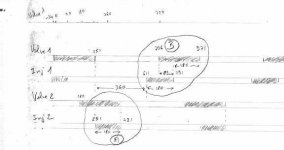
This took me a while to understand , so I made a draft on my way .

V1 : valve 1
I1 : injector 1
V2 : valve 2
I2 : injector 2

A : We want the I2 to open when the V1 close . V1 close at 251°.
It would be stupid to let I2 open while V2 is closed , or V1 will get the fuel later , running rich . So we close I2 at at or before V2 close , at 431° .
So I2 will be open from 251 to 431 = 180 °

B : I suppose it s logical to have I1 open the same lenght as I2 . So if we open I1 360° after I2 , it opens at 611° , but close at 791 ° V1 is still open . While I2 has squirted in an open valve , I1 squirt first on a closed valve . This valve will then be open for just 85° . Not the same pattern as V2

Questions :
A : even if we have the same amount of fuel in both cylinders , are 180° enough to fill them at 6000 RPM with 15 PSI boost ? It seems to be the same pb you mention .

B : will V1 open 85 ° during injection , while V2 is always open during injection , may cause a pb for tuning ?

I hope my draft is correct and my world clear enough :)

inject10.jpg
 
Nali,
I picked the 6000 rpm as a safe number for injector sizing, as there will never be a need to rev any STR-8 higher than that, although some of the racers here have revved up to 7000 rpm. Yes, with boost, we are talking forged pistons, but many experts here agree that the stock rods are plenty capable.

I'm going to use only 4 injectors (1 per port). You don't achieve anything by using 2 injectors per port, as they wouldn't fire simultaneously anyway. It doesn't affect injector sizing, either. 180 degrees being the maximum squirt window, you get 50% duty cycle with one injector and 25% with two injectors, and that's the only difference.

Yes, the number 2 cylinder gets it all on an open valve, while #1 gets part of it on a closed valve (all of it at idle) and partly on an open valve. I don't think the difference in fuel mixture will be significant, though.
 
Ok I got it .
I spend 2 hours thinking about it , and forgot you want to use only 4 injectors ... :clonk:
Even with my own draft it makes sense to me now .
I took a look on the Megasquirt documentation as an example , and it even seems that connecting 2 output from the controller to the same injector doesn t cause any problem , as they works by being grounded with a FET.

I used this doc and this schematic :
http://www.megamanual.com/index.html
http://www.megamanual.com/files/docs/MM40_V22Assembly.PDF

Finally , it seems very easy , so where s the trick ?
If I understand , we also don t need a cam sensor , a crank sensor is enough ...
The only bad new is a ViPEC V88 is about 2000 to 2600 $ ... So Megasquirt may be an option .
 
Yes, it looks clear when you make the necessary drawings to support your thinking, but trust me, even the head man at ViPEC didn't get it right. And so many people have failed in making it work.

With the ViPEC V88, it needs a cam sensor in order to run in the full sequential mode. The company who sold me the Procharger, also sells and tunes Autronic and ViPEC EFI systems. The Autronic won't do, as you are only able to set injection end point, and we need to set injection start point. The ViPEC allows you to set injection start point, midpoint or endpoint.

I asked around the dyno operators for their recommendations, and most of them won't tune a Megasquirt. On the other hand, they suggested Autronic or Motec, and said Haltech, ViPEC, and KMS would be OK.

With the HUGE 2000 cc injectors, in order to make the engine run properly at idle/low load, you must be able to set correction factors in the software. The ViPEC has the charts already in the software for the Injector Dynamics ID2000 injectors that I'm going to use.
 
Last edited:
I'm running tube headers already with the carb setup.

stock exhaust specs:
exhaust opens 56 BBDC
exhaust closes 25 ATDC

I'm always open for suggestions!
 
Jyrki
This is in reference to your EFI article on the roadmachine.fi website. I like your thought process and hope you find something in the following that is useful. As you stated the injection timing for cylinder #2 is critical and doesn’t begin until piston #2 is 71 degrees down the cylinder leaving 180 degrees until the intake valve closes. If we look at this from an airflow prospective we see the following. At very low engine rpm the air taken in during the intake stroke is pushed back out at the beginning of the compression stroke until the intake valve closes. As engine rpm increases the increased intake port air velocity counteracts this effect until at some point you are getting cylinder fill the total time the intake valve is open. So at low rpm cylinder #1 is pumping air out to #2 during a portion of the intake valve overlap time making it possible to start #2 injector closer to TDC for cylinder #2. Also consider that when the piston is 71 degrees down the intake stroke, a large amount of air has been taken into the cylinder before injecting fuel and it would seem that being able to inject earlier would be desirable. We also know that significant airflow doesn’t occur until the valve is off the seat far more than .004” leaving less than 265 degrees of intake duration to work with furthering the need to inject earlier. Possible Solutions: Looking at the cam timing, (Intake opens 14 BTDC closes 71 ABDC, Exhaust opens 56 BBDC closes 25 ATDC) if the lobes are symmetrical that puts the intake lobe center at 118.5 degrees ATDC and exhaust lobe center at 105.5 degrees BTDC with a lobe separation of 112 degrees. Figuring 112 degrees to be the “Straight up” cam position, that puts the cam at 6.5 degrees retarded. If we advance the cam it moves the intake overlap period earlier allowing injection sooner and advancing the cam also creates additional low end torque. Furthermore opening the intake valve sooner into the exhaust stroke may take advantage of the exhaust scavenging pulse created by the tube headers. Cam changes can include advancing intake lobes1,3,6 and 8 while retarding intake lobes 2,4,5 and 7 a few degrees (Scattered valve timing) to decrease intake valve overlap. If you add a supercharger, it would help if exhaust valve duration exceeded intake valve duration by a few degrees and adding a bunch of lift to both intake and exhaust valves really helps.
Paul
 
wow .. Punctuation could make this easy to read .
This is an usefulness option for most of people , but in real life , this really help .
Too hard too read , I gave up .

Sorry Nali

This is a result of putting too much detailed information in a small space.
I will send you a revised version.

Paul
 
FI can do anything you want to the fuel events.
It can't do anything to the air events.
Changing the lobes changes the air events in exactly the same way at all RPM - which is not what the engine is doing.
 
Let me add some clarification to my post.
Jyrki’s article addresses a possible approach to using an EFI unit he already has.
The decision is to use 1 large injector per intake port (4 total). The 2 cylinders being fed by each individual port will receive fuel by driving the injector every 360 degrees of crank rotation. The maximum injector ON duration is 180 degrees (50% duty cycle) and that is for 15 lbs of manifold pressure. The question is: What is the best time to begin injection so the second cylinder drawing from the intake port gets all of the fuel intended for it without sharing any with the first cylinder. From the mechanical analysis in the article, injection for the second cylinder would begin 71 degrees ATDC for that cylinder leaving just 180 degrees until the intake valve closed. If injection could occur sooner it would give more margin making delay times less critical and help insure complete fuel delivery for the second cylinder. Since the cam does control airflow events, working with it can improve the outcome. Correct me if my article summary is incorrect.
 
Jyrki
This is in reference to your EFI article on the roadmachine.fi website. I like your thought process and hope you find something in the following that is useful. As you stated the injection timing for cylinder #2 is critical and doesn’t begin until piston #2 is 71 degrees down the cylinder leaving 180 degrees until the intake valve closes. If we look at this from an airflow prospective we see the following. At very low engine rpm the air taken in during the intake stroke is pushed back out at the beginning of the compression stroke until the intake valve closes. As engine rpm increases the increased intake port air velocity counteracts this effect until at some point you are getting cylinder fill the total time the intake valve is open. So at low rpm cylinder #1 is pumping air out to #2 during a portion of the intake valve overlap time making it possible to start #2 injector closer to TDC for cylinder #2. Also consider that when the piston is 71 degrees down the intake stroke, a large amount of air has been taken into the cylinder before injecting fuel and it would seem that being able to inject earlier would be desirable. We also know that significant airflow doesn’t occur until the valve is off the seat far more than .004” leaving less than 265 degrees of intake duration to work with furthering the need to inject earlier. Possible Solutions: Looking at the cam timing, (Intake opens 14 BTDC closes 71 ABDC, Exhaust opens 56 BBDC closes 25 ATDC) if the lobes are symmetrical that puts the intake lobe center at 118.5 degrees ATDC and exhaust lobe center at 105.5 degrees BTDC with a lobe separation of 112 degrees. Figuring 112 degrees to be the “Straight up” cam position, that puts the cam at 6.5 degrees retarded. If we advance the cam it moves the intake overlap period earlier allowing injection sooner and advancing the cam also creates additional low end torque. Furthermore opening the intake valve sooner into the exhaust stroke may take advantage of the exhaust scavenging pulse created by the tube headers. Cam changes can include advancing intake lobes1,3,6 and 8 while retarding intake lobes 2,4,5 and 7 a few degrees (Scattered valve timing) to decrease intake valve overlap. If you add a supercharger, it would help if exhaust valve duration exceeded intake valve duration by a few degrees and adding a bunch of lift to both intake and exhaust valves really helps.
Paul

Paul.....I agree with what you have written.........but I think "scattered valve timing" is what is needed on these engines,with or without EFI........getting these paired vavles to share a equal amount is almost impossible (short of splitting the intake runners)......and when you add 13.5 to 1 compression, and 6000rpm's , just gets worse.

Dale
 
Back
Top