Clock conversion?

bittmann

Active Member
Has anyone had any experience (or know of any discussion) on swapping out the guts of the old mechanical clock for a battery -powered quartz?

My clock is easy to get to. It'd be simple enough to excize the old mechanism and put a high-torque quartz in its place.

But I don't want to take it apart if anyone knows that it's a lost cause. Like: No, the hands are a weird size and won't fit any modern mechanism today.

I am not excited about trying to revive the old clock since I'm in the habit of keeping the battery disconnected, and the "mother-may-i" to reconnect the battery and restart the clock seems a bit much.

But honestly? Neither am I excited about doing anything to the OEM clock anyway. Guess unless someone says "it's easy, here's the movement to get, wish I'd done it 10 years ago"... I'm probably just going to keep thinking, and not doing.
 
  • Like
Reactions: Bob
It would be nice if someone would upload a step by step! I have a kit in my toolbox for my clock which I have never got around to doing either.
I remember repairing a clock in a '67 Chevelle in the late 60's and all I did was clean the points that allowed the motor to wind it.
 
Aah, 12v stuff. Pity, doesn't help me, unfortunately. Although, hmm, wonder how long that would run on 8 AAs? I'd pay that for a sure thing if something like that would work.

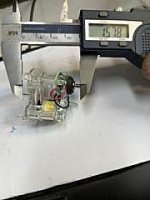
Ok. Meanwhile - if you have time, could you take a digital caliper to what you have and see what size (and shape?) the hour and minute shafts are? That would let us figure out if a cheap movement is even an option.

Eventually would need to measure how tall the stem is, too. And the diameter of the hole it goes through. To see if any of the commonly-available quartz movements might even be close.

But if the hands don't fit anything, not worth going any further!
 
You can get 6v to 12v converters. You will have to sort through this ebay link a bit, but there are quite a few different ones: CLICK HERE FOR EBAY CONVERTERS

.096" and .026" approx. for hour and minute. Outer is round plastic, inner is wire, also round.
Mechanism is about 1.665" diameter and and the depth is:1.578"
clock.jpg
 
Well, here's where I am so far. I am not terribly excited about a clock mechanism that runs off the car battery, since I'm paranoid enough to pull power from the battery when the car is garaged.

I don't find any quartz "replacement wall clock" mechanisms that have hand measurements even CLOSE to what Bob reported. On most of what I see, hour is closer to 0.20", minute to 0.15". I suppose I could drill out the hands to fit the quartz mechanism. That would definitely be a one-way trip, though.

Other alternatives? I could contact one of the companies that provide conversion mechanisms and ask if there is a 6V conversion available for my car, all I've found are 12V clocks. I also wonder if one of the automotive 12V clocks would run for any length of time off of e.g. an 8-battery array of AAs - that would keep the clock running even with the battery unplugged.

I can get a 6-12V booster if I need to, but I wouldn't necessarily want to leave something like that plugged in continually since they are not terribly efficient and are a power draw all by themselves. But who knows, maybe it wouldn't be any more draw continually than the intermittent clock-winding draw from the mechanical? Unsure. I think a "good" 6-12V boost circuit can easily pull 1mA or more continually on its own, not counting the draw from the load (clock). As opposed to the mechanical winder that pulls what, 3A for up to 1/100th to 1/50th of a second, something like 20-60 times per hour? So the booster may not be all that much of a draw in comparison.

Or I can just live with not having a working clock, which is the default.
 
Just a thought:
I don't drive my car regularly enough :( , so when I park it I have a battery maintainer and desulphator that I keep plugged in. I have found that my battery lasts a good deal longer than it would without a maintainer on it. IF that sounded good, you would not need to worry so much about the low draw of a clock or voltage converter.
 
The electrons are flowing from battery through harness when battery is connected. I figure they just get tired going back and forth. If you just add in a battery disconnect than there is no need to waste electric grid with the maintainer. The sulphating process occurs if you start the car and shut it down in a hurry after you just wanted to move it a bit. Best practice is if you start car for any reason just have to wait about guessing minimum 7 min. For longer battery life before shutting down. Goes to the argument if you can just put into neutral and let it roll that bit instead of starting just to move that bit. If you are physically chalkenged then you cant.

In regards to quartz clock, not worth doing anything if your car is in storage most of the year. Better spend effort in $100 GPS unit that has maps, time, speed alerts, etc. Change your cigar lighter to USB port so you can plug in GPS. Leave the old clock in as a trophy.
 
It's a trophy now. It's always high noon in the Buick!

I definitely have bigger fish to fry. But replacement quartz movements are so stupid cheap, thought it was at least worth exploring.
 
Back
Top